
Lately, I have been seeing more and more posts online where people react very emotionally to the very idea of tracking working time. For some, the word “timesheet” already sounds like a warning sign. They see it in a job description or hear it during an interview that the company expects people to report the time they spend on work, and the conversation is almost over before it begins.
I partly understand this reaction.
Timesheeting can indeed be unpleasant. It can become a tool of petty control, a digital whip, or a way of showing people they are not trusted. It can become yet another bureaucratic exercise that everyone is forced to perform, while no one actually uses the data to make decisions.
But the problem is not timesheeting itself.
The problem is why it is introduced, how it is implemented, who looks at the data, what decisions are made based on it, and whether people understand what the company is actually trying to see behind those hours.
I look at this topic from several roles at once: as a co-owner of companies, a director, a project manager, and someone who also does the work personally. That is why, for me, timesheeting is not a matter of belief, fashion, or corporate discipline. It is a matter of management. When it is needed, it is truly needed. When it is not needed, it is better not to touch it, because unnecessary reporting does not make a company more mature. It simply makes it heavier.
Why Report Time at All?
To put it simply, reporting is needed to determine how much time was spent and to make decisions based on that information.
We do not report because someone loves tables. At least, I sincerely hope that is not the reason. We report when we want to understand what happened to our plans after they met reality.
A family planning a renovation needs to understand how much they expect to spend, how much they actually spent, and why there is a gap between those numbers. A company launching a new business direction needs to know not only that “we worked a lot,” but how much time, money, attention, and energy the launch actually consumed.
Of course, there are situations where the facts are not particularly important. For example, Grandma Nastya sends her grandson to the garden and says, “Go and eat some strawberries, my dear.” I am almost sure Grandma Nastya does not care much whether he ate two, four, ten, or perhaps not even her strawberries at all.
But business is not strawberries in the garden.
In business, projects, consulting, software development, training, customer support, or the creation of new products, facts matter because without facts, we live in assumptions. We assume that a project is profitable, that the team is fully loaded, that a new feature costs approximately this much, and that we are spending enough time on marketing. Then the numbers arrive, and it turns out that reality has its own opinion.
Plan, Fact, and Mature Management
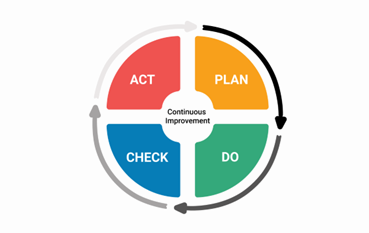
Any mature management system is based on a simple logic: we plan something, then we do it, then we look at what actually happened, draw conclusions, and plan the next step a little more intelligently.
This is the logic behind the Deming cycle: Plan, Do, Check, Act. The same idea lives inside sprints, retrospectives, project management, portfolio management, operational efficiency, and most healthy management practices.
We cannot improve what we do not see.
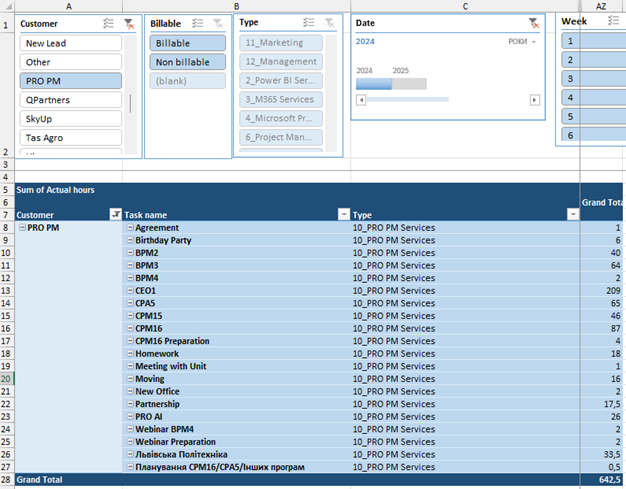
And this is where simple but uncomfortably specific questions appear. How many hours did it take to write a book? How much time did the team spend on a program, a product, or a client project? How much has the development of LEO Gantt cost so far? Can we see that the team is approaching its limit and that it is time to look for new lucky people to join our company?
These questions can be answered with something like, “Well, it feels like a lot,” or “I think we did not spend enough time on it.” But they can also be answered with numbers. And the difference between those two options is the difference between managing through emotions and managing through facts.
I am not saying that facts are always perfect. Nor am I saying that numbers are automatically wiser than people. But numbers remove part of the fog, and in management, sometimes even that is enough to avoid walking confidently into a wall.
What Is Timesheeting?
Timesheeting is the process of recording the actual working time spent across days, tasks, projects, clients, or types of activity.
In other words, it is an attempt to answer not only the question “what was done,” but also “how much time did it take,” “when exactly was that time spent,” and “which project, product, client, or internal process should this time be assigned to.”
You can say, “The article took 12 hours to write.” That is already useful information. But you can say it more precisely: on Monday, it took 2 hours; on Tuesday, 3 hours; on Thursday, 4 hours; and on Friday, another 3 hours. Then we see not just the total number, but the distribution of work over time.
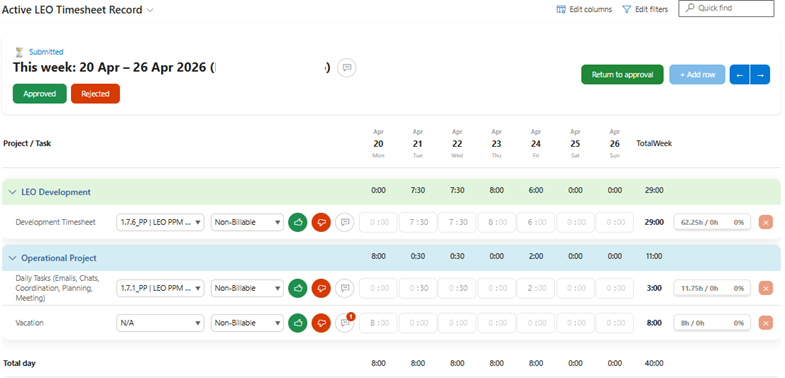
That second option is timesheeting in the direct sense of the word.
Its value is not in recording every movement a person makes. Its value is in showing the structure of time spent. Because when we see the structure, we can analyse it, draw conclusions, and change the system, rather than nervously discussing why everything once again took longer than we expected.
Why Not Just Remember Later?
At this point, a logical question always appears: why can’t people simply say later how much time they spent? Why does it have to be recorded?
In theory, they can. In practice, human memory was not designed for this.
People forget whether they turned off the iron, where they left their keys, and whom they promised to call back after lunch. So if we sometimes cannot accurately remember what we were doing on Tuesday at 3 p.m., expecting a person to reconstruct, two weeks later, the time spent across five tasks, three projects, and several internal activities is not managerial trust. It is managerial romance.
That is why timesheeting does not guarantee perfect accuracy. And we should not pretend that it does. But it significantly reduces the level of imagination in management.
And that is already quite a lot.
When Timesheeting Is Needed
Timesheeting isn’t required for everyone, and it’s not always required. But there are situations where, without it, a company or a project begins to live with its eyes closed.
First of all, it is needed when the information about time spent is actually processed and used for decision-making. If people fill in timesheets and the data then lies dead somewhere in the system, that is not management. It is a ritual. In that case, it is better to admit honestly that the company has simply created another way to annoy people.
But if managers use this data to assess team workload, project costs, client profitability, estimation quality, hiring needs, or process improvement, then timesheeting stops being bureaucracy and becomes a normal management tool.
The second important reason is the real cost of work. In service businesses, consulting, software development, system implementation, support, training, and project-based work, time very quickly turns into money. If a company does not know how much time it spent on a project, it does not know the project’s real cost. A project may look profitable in invoices but be loss-making in hours.
The third reason is contractual obligations. If a contract defines a number of hours, hourly payment, a work limit, or a transparent level of contractor involvement, then timesheeting becomes part of a normal client relationship. The client has the right to understand what they are paying for, and the provider has the right to show what work was done and how much time it took.
The fourth reason is people’s workload. Of course, you can simply ask a person, “Are you busy?” And the answer will almost always be predictable: “Yes, I am busy.” But this does not explain exactly what they are busy with, how overloaded they are, whether there is an overload, whether invisible support work is consuming half of their time, whether it is really necessary to hire another person, or whether it would be enough to remove a few foolish processes.
Timesheeting shows not the feeling of workload, but the structure of workload. And those are very different things.
A separate case is when payment is tied to the number of hours worked. There is not much philosophy here. If a person or contractor is paid by the hour, then without time tracking, there is no basis for calculation.
When Timesheeting Is Not Needed
Timesheeting is unnecessary when a company has no answer to the question: “What are we going to do with this data?”
If no one analyses the hours, no one makes decisions based on them, no one reviews estimates, changes planning, studies workload, calculates cost, or works with project profitability, then timesheeting is not needed.
It may also be unnecessary in stable operational processes where the work is repetitive, the volume is clear, results are measured by other indicators, and time spent is not a key management variable.
And it is definitely not worth introducing timesheeting to show people that the company “has its finger on the pulse.” Very often, this is not a finger on the pulse. It is a hand on the throat.
If timesheeting is needed only to make sure people “do not relax,” it is bad timesheeting. If a manager wants to check in every 15 minutes, not because it helps the business, but because they feel psychologically safer when everyone is under observation, then the problem is not with people or time tracking. The problem is with the management culture.
Who Should Fill In Timesheets?
I follow a fairly simple principle: people working in development, R&D, projects, product creation, commercial work, consulting, or change implementation usually need timesheeting.
Because this is where cost matters. This is where tasks often do not repeat in exactly the same way. This is where estimates can differ significantly from actuals. This is where the team often works on several projects at the same time. This is where it is easy to lose the real picture if you look only at general impressions.
For those who “sit on processes” in the stable operational part of the business, detailed timesheeting may be less critical. This does not mean operational roles do not need to report. Everyone needs to report on the work done. But the reporting format may be different.
Some roles need hours by task. Some need completed operations. Some need SLA indicators. Some need the number of processed requests. Some need quality of output, response time, error rate, or customer satisfaction.
Timesheeting should not replace common sense. It should appear where time is truly an important management variable.
What Types of Timesheeting Exist?
There are several main approaches to time tracking, and they differ not only in accuracy but also in how people perceive them.
The first option is automatic activity tracking. This is when software is installed on a work computer and tracks which applications a person uses and how much time they spend in the browser, email, documents, messengers, or specialised systems.
From the point of view of accuracy, it may look attractive. From a cultural perspective, it is very risky. This approach can easily become digital surveillance, and where surveillance begins, trust quickly ends. People start thinking not about how to work better, but about how to look busy in the eyes of the system.
The second option is timer-based tracking. A person starts working on a task, starts the timer, finishes the task, and stops the timer. This approach is often used in service, consulting, legal, design, or IT teams, especially when hourly payment or detailed tracking is required.
Timers provide better accuracy, but they require discipline. A person may forget to start the timer, forget to stop it, switch to another task, go to a meeting, come back, answer a message, and the accuracy is no longer as perfect as the system promised.
The third option is the classic timesheet. At the end of the day or week, a person records the actual hours spent on tasks, projects, clients, or work categories. This is the least accurate of the three approaches, but often it is the healthiest compromise.
Yes, it does not provide perfect accuracy. But it also does not turn work into a constant stream of button-pressing. It allows the company to see the general picture, calculate costs, analyse workload, and draw conclusions without pretending that every breath of a person can or should be measured to the second.
In our company, we use exactly this approach. We use regular timesheeting without automatic surveillance or a cult of the stopwatch, mainly for teams involved in development projects or commercial work. We do not need perfect accuracy for the sake of perfect accuracy. We need sufficient accuracy for normal management decisions.
Good Timesheeting Is Not Micromanagement
It is important not to confuse timesheeting with micromanagement.
Timesheeting is a tool for recording time. Micromanagement is a management style in which a manager does not trust people, interferes in every detail, and controls not the result or the system, but almost every movement.
Timesheeting can become part of micromanagement. And then, of course, it will cause resistance. But by itself, timesheeting is not micromanagement.
Bad timesheeting is when people are forced to fill in dozens of tiny categories, are criticised for every hour, are not told why the data is needed, do not see how it is used, and experience time reporting as a tool of punishment.
Good timesheeting looks different. There are not too many categories. The logic is clear. The data is actually used. People see that decisions are made based on the numbers: estimates are revised, processes are reviewed, prices are raised, new people are hired, inefficient activities are eliminated, or, conversely, the value of previously invisible work is confirmed.
In other words, good timesheeting does not remove trust. It adds facts to trust.
Conclusion
Timesheeting in itself is neither good nor bad. It is just a tool, and its value depends not on tracking time itself, but on why a company introduces it, how it explains its purpose to people, and what it does with the data afterwards.
If timesheeting is used for total control, distrust, and punishment, people will hate it. And rightly so. If it is used to understand the real cost of work, team workload, project profitability, estimation quality, and process improvement, then it is a normal management tool.
As a manager, I need to know how much our projects really cost. How much does product development cost? How much time does the team spend on commercial work, internal initiatives, support, learning, and development?
Not because I want to count every minute.
But because I want to see reality.
There are different ways to manage. You can manage based on feelings, intuition, impressions, the loudest voices in the room, or whoever is most convincing in explaining how busy they are.
Or you can add facts.
And timesheeting, if we do not turn it into a cult or use it as an instrument of petty control, exists exactly for this purpose. It does not replace trust, common sense, or managerial responsibility. But it gives us something without which mature management quickly turns into conversations about feelings.
It gives us the ability to see where time actually goes.
And as time goes on, the company goes as well.